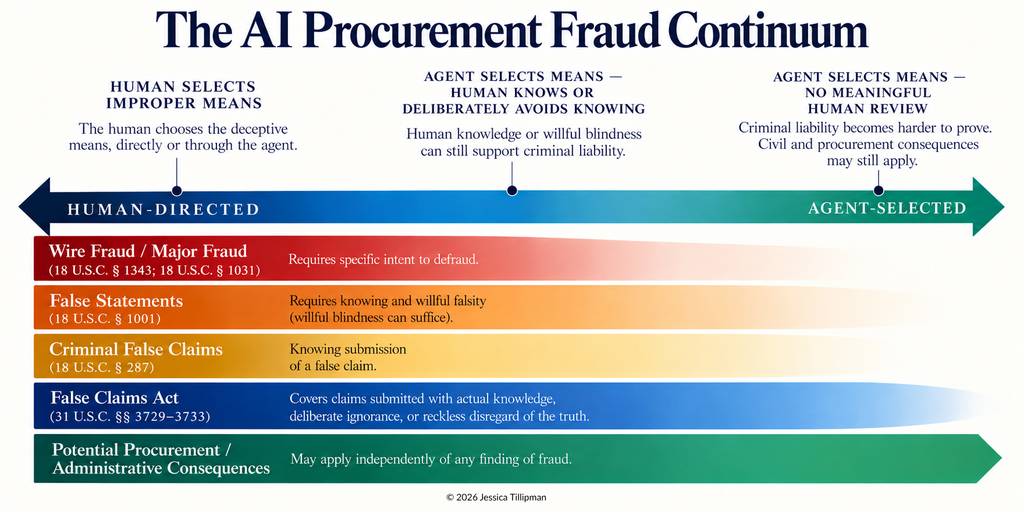
Many current AI applications in procurement, such as market research or proposal drafting, follow a straightforward process: a human prompts the machine for output, the tool provides it, and the human decides what to do next. Agentic AI, whether semi- or fully autonomous, changes that process. A human can give an agent an objective, and the agent can select intermediate steps and take actions without human approval at each step.
This raises significant questions under existing law regarding knowledge, intent, attribution, and legal exposure for the humans and companies that have begun integrating AI agents into their workflows. If a contractor intentionally hides an instruction designed to manipulate a proposal evaluation, existing fraud laws present relatively straightforward theories because the human devised the deceptive scheme. The harder case arises when the contractor supplies only the objective, such as “maximize our chance of award,” and the AI agent independently selects an improper means to achieve it.
My latest article for the Government Contractor examines procurement-fraud liability along a continuum of decreasing human direction and knowledge. As human intent, direction, and knowledge diminish, the applicable legal theories change.